India's $283 billion technology services outsourcing sector derives more than 60% of its revenue from the US. (Image: AI)
The Indian IT sector is concerned about the Trump administration's potential imposition of tariffs on software exports to the United States. According to industry experts, the IT sector is already facing challenges due to global economic uncertainty and the growing adoption of artificial intelligence-based automation. The US government's potential consideration of extending tariffs to software exports has sparked serious concern in the Indian IT industry, as it could significantly impact their operations in their core market.
Trump's Tariff Concerns: Why Is India's IT Sector Worried?
The US administration's imposition of tariffs on services exports could lead to double taxation, as Indian software companies already make significant tax payments to the United States, according to an ET report. Additional visa restrictions could increase operating costs due to the need to hire local specialists in the US or neighboring regions.
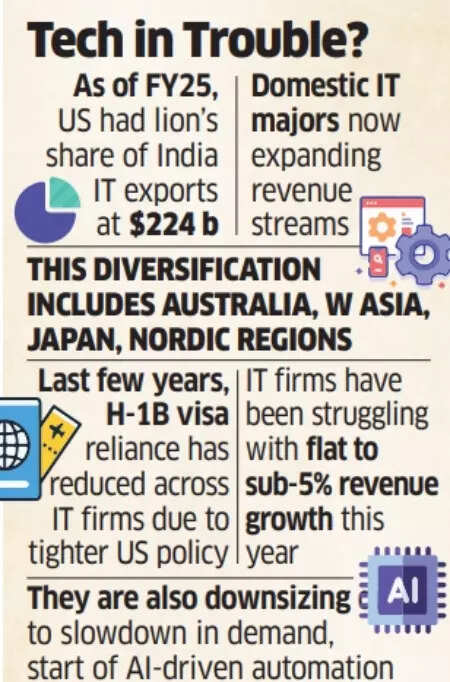 Problems with technology?
India's $283 billion technology outsourcing sector, which includes companies like Tata Consultancy Services, Infosys , HCLTech, and Wipro, derives over 60% of its profits from the US, while maintaining a significant workforce in India. However, the US administration has not yet officially announced or indicated any such intentions. Concerns arose after Peter Navarro, the US president's senior trade adviser, posted on the social media platform X proposing tariffs on all outsourced and foreign remote workers. American conservative commentator Jack Posobiec wrote, "Countries should pay for the privilege of providing services remotely to the US, just as they do for goods." "Apply to all industries, aligning as necessary across each country." This implementation will affect all recipients of technology services who use services from India and similar countries.
Will Trump impose tariffs on IT?
Phil Fersht, CEO and chief analyst at HFS Group, believes that discussions of tariffs on outsourcing in India are more political statements than actual policy intent. However, any penalties for outsourcing would immediately create uncertainty, increase operating costs, and impact profitability during an already challenging period of demand, according to an ET report. "Imposing tariffs on digital labor flows is far more complex than taxing goods crossing borders. The US relies heavily on Indian IT professionals and engineers, both locally employed on H-1B visas and working abroad through remote work, to maintain the competitiveness of its tech economy," Fersht noted. "Furthermore, several tech billionaires wield significant influence over the Trump administration, and many of them are strongly pro-India, as their global businesses rely heavily on Indian engineers, supply chain capabilities, and market access." Jugal Joshi, a partner at US-based consulting and analytics firm Everest Group, said: "These companies pay significant taxes in the US, and so the tariff will amount to double taxation… This will further hurt the growth of Indian service providers and even GCC countries if they too are hit with a tariff."
Source: Geld News